J&K Blast Kills 9 Trying to Check Seized Explosives

Home Minister Amit Shah holds urgent consultations with the top echelons of the J&K police hierarchy; Directs swift escalation of investigative resources
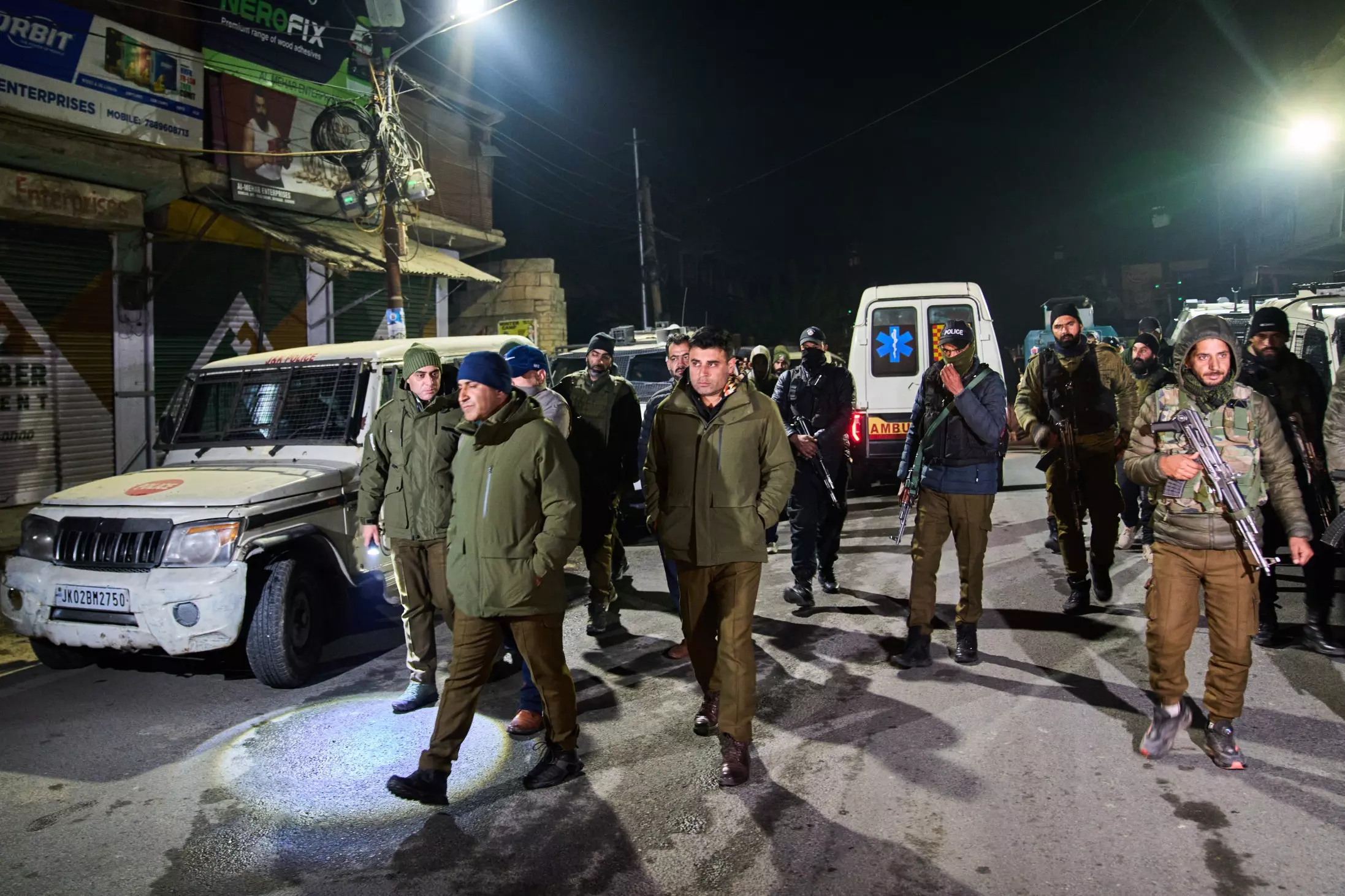
Srinagar: A massive accidental explosion at Srinagar's Nowgam police station late on Friday night killed nine people and injured 32 others, officials said. The casualties could rise, as five of the injured remain in critical condition.
The tragedy unfolded at 11.20 pm during a routine but high-stakes forensic operation. A joint team of police officers, forensic experts and administrative officials was meticulously extracting samples from a massive cache of over 360 kg of seized explosives, primarily ammonium nitrate, recovered earlier in the week. The explosives recovered from the rented residence of arrested doctor Muzammil Ganaie, a lecturer at Al-Falah Medical College in Faridabad, Haryana, had been transported to the police station for examination several days ago.
These materials were part of an intricate investigation into a “white-collar" terror ecosystem allegedly tied to the Pakistan-based Jaish-e-Mohammed (JeM) militant group. This haul was just a fraction of a staggering 2,900 kg of explosive material and an arsenal of sophisticated weapons seized during a 15-day operation that cracked open a shadowy network exploiting professional and academic circles to fund and propagate terror, officials said.
The deceased are J&K state intelligence agency (SIA) officer inspector Asrar Ahmed Shah, naib tehsildar Muzaffar Ahmed Khan, selection grade constable Aijaz Afzal Mir, constables Muhammad Amin Mir and Showkat Ahmed Bhat, crime branch photographers (constables) Arshad Ahmad Shah and Javaid Mansoor Rather, alias Mubashir, tailor Muhammad Shaffi Parray and chowkidar of the area Suhail Ahmad Rather. Their bodies were shifted to the police control room (PCR) here for post-mortems amid heart-wrenching scenes of grief-stricken families. The victims were buried in their respective family cemeteries later during the day.
The 32 injured, predominantly security personnel, along with two additional revenue officials and three civilians from nearby areas, were swiftly evacuated to the nearby Ujala Cygnus Kashmir Super Specialty Hospital and the government-run SMHS Hospital for immediate care. Those in critical condition were transferred to the Army’s 92 Base Hospital in Badami Bagh Cantonment and the Sher-i-Kashmir Institute of Medical Sciences (SKIMS) in the Soura quarter of the city for advanced treatment.
The catastrophic blast obliterated the police station compound in a cataclysm of fire and twisted metal. Several police jeeps, forensic vans and motorcycles parked inside were reduced to grotesque heaps of charred, crumpled steel, frames bent like paper, tyres melted into the asphalt and shards of windshield glass glittering across the debris like lethal confetti.
Flames devoured the makeshift hutments that housed the explosives storage and documentation units, their corrugated roofs collapsing inward as orange infernos roared skyward, belching thick black smoke that hung over Srinagar like a shroud. The once-orderly yard, now a cratered moonscape of scorched earth and scattered wreckage, bore witness to the sheer violence of the detonation, with fragments of vehicles and station infrastructure hurled up to 200 metres away, embedding in neighbouring homes, and shattering the night’s fragile calm.
“The force of the explosion was so devastating that body parts of some of the victims were recovered from nearby house courtyards, up to 200 metres away,” a resident said.
Another recalled, “We thought a massive earthquake had struck or that it was doomsday itself. The ground shook violently, windows shattered in a wave and the sky lit up like a bomb had fallen. For a second, we didn’t know if we were alive.”
The deafening roar, followed by a shockwave that rattled homes even at Naseem Bagh, a Dal Shore area 18 km away where this correspondent lives, left families clutching each other in the dark, hearts pounding from a sound all too familiar yet never less terrifying in Kashmir’s long night of unrest.
Medical teams reported treating blast-related trauma, shrapnel wounds and burns, with the most critical cases involving internal injuries from the concussive force.
The Nowgam police station had been at the forefront of unravelling this terror module, which authorities described as a sophisticated “white-collar” operation blending respectability with radicalism. The probe ignited after JeM posters surfaced in the area, ominously warning of major attacks on security forces and “outsiders” in Kashmir.
CCTV footage from October 27 led to the arrest of Dr Adeel Ahmad Rather, a former employee of Government Medical College Anantnag who had relocated to Saharanpur, Uttar Pradesh. An assault rifle was recovered from his locker. Interrogations quickly pointed to Shakeel in Faridabad, whose arrest on Monday was followed by that of Dr Shaheen Saeed, a Lucknow resident at the same medical college.
The same evening, a car bomb detonated near Delhi's iconic Red Fort, claiming 13 lives and injuring over 20 in a brazen assault. The National Investigation Agency (NIA), leading the probe, identified Dr Muhammad Umar Nabi as the driver of the Hyundai i20 used in the blast, with DNA evidence from the site matching samples from his mother in Kashmir Valley’s southern Pulwama district.
In a swift retaliatory measure, security forces demolished Nabi's residential house in a controlled operation in the Koil area of southern Pulwama on the intervening night of Thursday and Friday.
The broader conspiracy, linking JeM with the al-Qaeda-linked Ansar Ghazwat-ul-Hind (AGuH), exploited doctors, academics, and imams, like the arrested mosque imam Moulvi Irfan Ahmed, to launder funds and procure arms under the guise of legitimate professions, officials said.
In a marked escalation of the crackdown, the J&K police's Counter-Intelligence Kashmir (CIK) wing raided 16 locations across the Kashmir Valley on Thursday, targeting suspected JeM operatives and overground workers (OGWs). Supported by local police and other agencies, these operations—initiated on intelligence from the J&K crime investigation department (CID)—aim to dismantle cross-border linkages, officials said.
“With the investigation now entrusted to the CID, we conducted raids at 16 locations today. Further operations are underway to penetrate deeper into this white-collar terror ecosystem and fully unravel the conspiracy,” a senior officer told this newspaper, emphasising the probe's focus on the Srinagar-based JeM cell behind the Delhi attack.
J&K director-general of police (DGP) Nalin Prabhat arrived at the scene early Saturday morning to survey the wreckage and brief his team.
Inspector-general of police (IGP) Kashmir Vidhi Kumar Birdi joined him to scrutinise the circumstances.
The J&K DGP dismissed any speculation over the cause of the massive blast at the police station, terming it “unnecessary”, while confirming nine fatalities and 27 injuries in the incident.
Addressing the media after inspecting the heavily damaged site, Mr Prabhat explained that a large quantity of explosives, recovered from Faridabad during an ongoing investigation, had been transported to Kashmir and securely stored in the open area of the Nowgam police station as per standard protocol.
“As part of the prescribed procedure, samples of the recovered material were being prepared for forensic and chemical examination. Due to the voluminous, sensitive and unstable nature of the explosives, the sampling process, initiated yesterday, was being conducted with extreme caution,” he said. Despite these measures, an accidental explosion occurred at 11.20 pm on Friday.
“Any other speculation into the cause of this incident is unnecessary,” Mr Prabhat stressed, adding that a detailed inquiry has been ordered to ascertain the exact circumstances.
The DGP added: “The J&K police stands in full solidarity with the bereaved families in this hour of grief and prays for the speedy recovery of the injured.”
In a post on X, the Kashmir zone police said, “The DGP and all ranks of J&K police convey their solemn tributes to Inspector Asrar Ahmad and all team members who made the ultimate sacrifice in the line of duty.”
The police rejected as false and mischievous the online claims reportedly made by the People's Anti-Fascist Front (PAFF), an obscure group believed to be linked to Pakistan-based militant groups, regarding the deadly blast. “The claim of PAFF or any other Pakistani terrorist group is patently false, baseless and mischievous!” it said in a post on X, reaffirming the accidental nature and vowing no let-up in the fight against terror.
In a decisive move to quell swirling rumours and online misinformation, the ministry of home affairs (MHA) in New Delhi officially confirmed that the devastating explosion at the Nowgam police station was unequivocally accidental, ruling out any terror involvement.
Addressing a press conference, joint secretary Prashant Lokhande from the MHA's J&K Kashmir division emphasised the incident's procedural origins, stating, “Yesterday, on November 14, at 11.20 pm, in an unfortunate accidental incident, a massive explosion took place inside the Nowgam police station in Jammu and Kashmir.”
In a parallel development underscoring the Central government's hands-on response, Union home minister Amit Shah reportedly held urgent consultations with the top echelons of the J&K police hierarchy shortly after the blast, directing a swift escalation of investigative resources. Sources indicate Mr Shah instructed the immediate deployment of the NIA, National Security Guard (NSG) and advanced forensic teams to the site for comprehensive residue analysis, DNA matching, and structural assessments, measures aimed at ensuring no procedural lapses contributed to the tragedy while fortifying the ongoing crackdown on the terror module.
At the PCR, lieutenant-governor Manoj Sinha led floral wreath-laying ceremonies for the nine fallen, draping the national Tricolour over their caskets as devastated families wept openly.
J&K chief minister Omar Abdullah assured comprehensive compensation packages for the kin of the deceased and medical support for the injured.
