Women’s Safety And Bengal’s Shifting Electoral Mood

The shift has been gradual. Incidents like RG Kar, Sandeshkhali, and the Kasba Law College case have not faded as quickly as such stories used to. Instead, they have lingered in people’s minds, creating a sense of continuity rather than interruption.
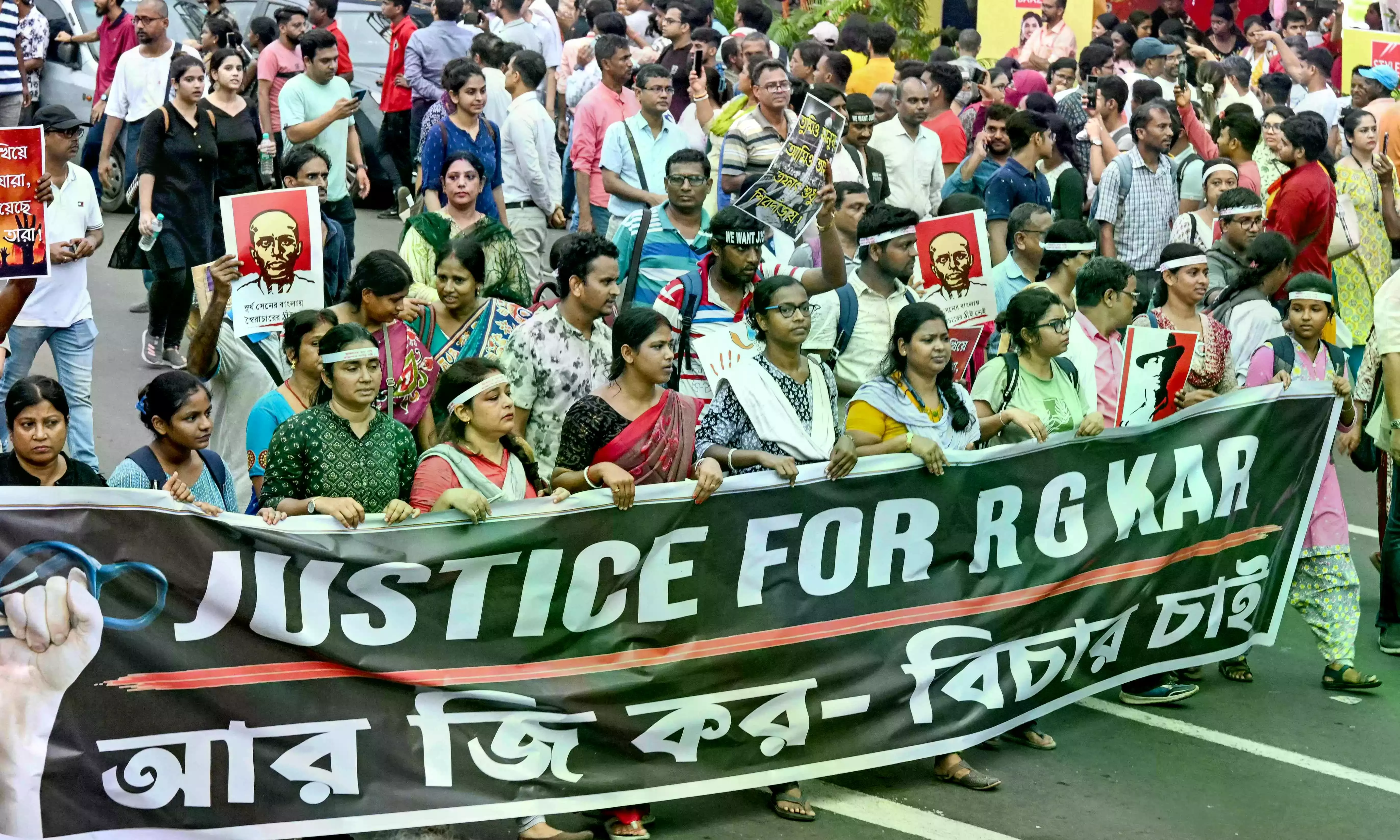
There are moments in politics when an issue stops appearing in fragments and begins to settle into something more persistent. In West Bengal, that moment seems to be taking shape, not through a single flashpoint but through an accumulation of events that have steadily altered public conversation. Women’s safety, once episodic in political discourse, now carries a different kind of weight.
The shift has been gradual. Incidents like RG Kar, Sandeshkhali, and the Kasba Law College case have not faded as quickly as such stories used to. Instead, they have lingered in people’s minds, creating a sense of continuity rather than interruption. What emerges is less a cycle of outrage and more an unease, one that increasingly shapes how governance itself is being judged.
The data reinforces this perception. West Bengal recorded over 34,000 cases of crimes against women in 2023, alongside the highest share of acid attacks in the country. Conviction rates remain among the lowest, with a large number of cases still pending. These are not just numbers, they shape how credibility is assigned to these institutions.
Elections, in such moments, tend to absorb these undertones rather than manufacture them. For Bharatiya Janata Party, this has resulted in a more deliberate and continuous focus on the issue, integrating it into a broader conversation on governance rather than treating it as an isolated concern.
There is a recognizable strategic imprint on this approach, shaped by Amit Shah’s campaign style in the state. He has focused less on rhetorical escalation and more on consolidation, aligning organizational effort with a narrative that connects law and order to governance more broadly. His repeated visits, extended engagement with party workers and focus on booth-level strengthening reflect an attempt to build depth rather than rely on surface momentum.
This is further visible in how the campaign balances symbolism with structure. There has been outreach, meeting victims’ families, acknowledging their grievances, and in a notable instance, giving electoral representation to the mother of the RG Kar victim. The signal is clear. Under Amit Shah’s direction, the party seeks to position itself alongside those who have been wronged, rather than speaking about them at a distance.
At the same time, this positioning is paired with policy commitments. The promise of 33 percent reservation for women in government jobs, financial support schemes, and the creation of ‘Durga Suraksha Squads’ are framed as institutional responses rather than isolated assurances. Taken together, they suggest an effort to treat women’s safety as part of a larger governance framework, not a peripheral concern.
The cultural layer of this framing is difficult to miss. Bengal’s public life is deeply intertwined with the symbolism of Durga, a figure representing strength, resilience, and protection. The contrast that is now being drawn is implicit but pointed, society that reveres feminine power, yet struggles to guarantee everyday security for its women. It is a line of argument that resonates not because it is new but because it connects cultural identity with lived experience.
The response from TMC has often been to contest this framing. Yet, at moments, it has also appeared uneven. Remarks suggesting that women should avoid stepping out after a certain hour have drawn criticism for shifting the burden of safety onto individuals rather than institutions. This tension, between perception and response, has allowed the issue to persist rather than dissipate. In contrast, the Union Minister has framed the issue in more expansive terms, suggesting that under BJP’s leadership, even a young girl will be able to ride out on a scooter at 1 am without fear.
Within this, BJP’s articulation has been relatively direct. The argument is not only that law and order has weakened, but that accountability has been inconsistent. Campaign messaging has repeatedly pointed to cases where alleged perpetrators were seen to enjoy political protection, reinforcing a perception, fair or otherwise of selective enforcement.
Beyond women’s safety, this narrative extends into adjacent concerns. Corruption scandals, questions around infiltration and uneven implementation of central schemes are all positioned as part of a broader governance deficit. Shah’s strategy appears to be to layer these issues, allowing each to reinforce the other rather than exist in isolation.
At the same time, the campaign has sought to project an alternative. Promises of economic revival, industrial investment, and administrative reform are placed alongside welfare commitments, attempting to move the conversation from critique to proposition. Whether this balance holds will depend on how convincingly these promises are received.
In a state where electoral choices have traditionally been shaped by identity, welfare networks and leadership familiarity, this introduces another layer, one that links governance more directly with everyday security. That does not automatically translate into political change. TMC continues to retain a deeply rooted organizational structure and a welfare architecture that has, over time, built durable voter relationships.
Elections are rarely decided on a single axis. They evolve when new considerations begin to sit alongside the familiar, gradually reshaping how choices are made.
In Bengal, that realignment now appears less speculative and more discernable. As questions of women’s safety, governance and accountability move closer to the center of political judgement, BJP, under the strategic direction of Amit Shah, appears increasingly in step with that shift. It is positioning not just a critique of the present, but a case for change. And when the grammar of political choice begins to alter in this manner, it often signals the possibility of a larger transition.
The writer, Bagmita Borthakur, is a PhD Research Scholar from BITS Pilani.
