Royale Touche Helped Reframe Laminates in India’s Interior Design Market

Royale Touche gives clients exposure to global design trends
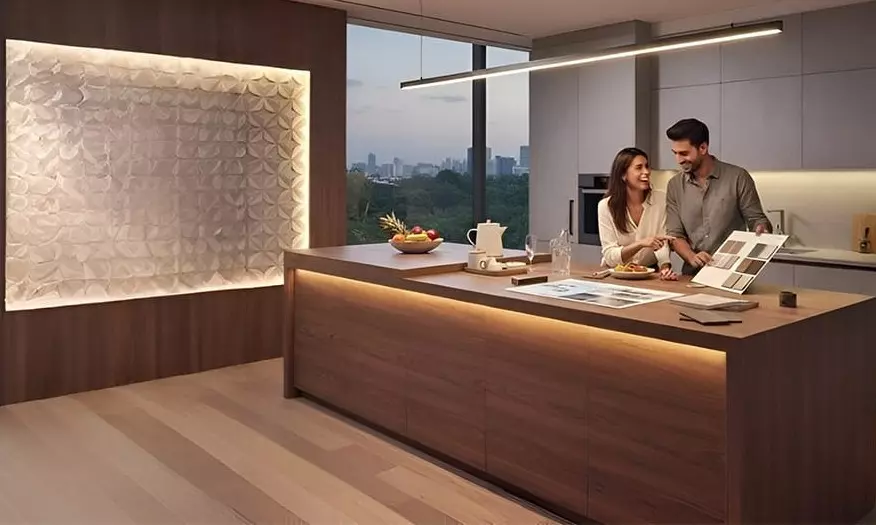
In India’s interior materials industry, laminates were long treated as functional, price-driven products—used where necessary but rarely discussed as a design element. The evolution of Royale Touche reflects a gradual shift away from that mindset, mirroring broader changes in how Indian homes and workspaces began to be imagined from the late 20th century onwards.
The company traces its origins to a small laminate manufacturing unit set up in Gujarat in the late 1970s by four brothers—Dinesh Patel, Jitendra Patel, Arvind Patel and Bharat Patel. At the time, the domestic laminate market was limited in both scale and design ambition. Most products were positioned as low-cost, durable surfaces, with little emphasis on aesthetics or user experience.
From its early years, the promoters adopted a view that differed from prevailing industry norms. Instead of treating laminates purely as industrial outputs, they positioned them as everyday surfaces that influence how people experience their living and working environments. This perspective—articulated internally as a focus on comfort, usability and longevity—shaped product development decisions during the company’s formative years.
As international laminate manufacturing and surface design advanced, particularly in Europe, the company closely tracked these developments. This coincided with a slow but visible change in India’s interiors market, where architects and designers began seeking greater variety in textures, finishes and colour palettes. Royale Touche responded by introducing European manufacturing technology and releasing design-led catalogues that showcased contemporary surface options. For many design professionals at the time, these catalogues became practical reference material in the absence of widely available alternatives.
Expansion followed demand rather than rapid scaling. The company gradually added manufacturing capacity, regional depots and exclusive showrooms, while also entering export markets. This period marked a shift in how laminates were marketed in India—less as a commodity and more as a design decision—placing Royale Touche among a small group of domestic brands attempting to reposition the category.
A generational transition in leadership brought further structural changes. With Raj Patel and Shiv Patel taking on operational responsibilities, the focus moved towards systematization and process discipline. Enterprise software platforms were introduced to manage inventory, procurement, logistics and dealer relationships, reducing reliance on manual coordination as the organisation grew in size and geographic spread.
Despite these changes, organisational continuity remained notable. A significant proportion of the workforce has remained with the company for decades, spanning phases of manual production, early automation and modern manufacturing practices. Former and current employees often point to the founders’ direct involvement in quality oversight—sometimes extending to dispatch processes—as an influence on the company’s internal standards.
In recent years, the company has adapted to a more digitally driven and retail-oriented market. Online systems, structured dealer networks and an expanded product range now form part of its operations. At the same time, the company operates in a far more competitive landscape, with both domestic and international players vying for share in a design-conscious but price-sensitive market.
Viewed in a broader industry context, the journey of Royale Touche illustrates how shifts in consumer taste, exposure to global design trends and incremental organisational change have reshaped India’s laminate sector. Rather than a single disruptive moment, its growth reflects a series of measured responses to evolving expectations—both within the interiors industry and among Indian consumers themselves.
