On the occasion of Science Day, let us try to recall a few women scientists whose contributions led to development in various areas
National Science Day is celebrated on February 28 every year marking the discovery of scattering of light, called the Raman effect, by renowned physicist CV Raman in 1928, for which he earned the Nobel Prize in Physics in 1930. Raman is the first Asian to receive the honor in sciences. In addition to being a tribute to the scientist's breakthrough, the day is celebrated to give a push to scientific temper and innovation in the nation.
Every year, the Government of India, through the Ministry of Science and Technology's Department of Science and Technology (DST), will organize the national-level celebration at Vigyan Bhawan in New Delhi on this day. Other leading research institutions in the country are also organising outreach progammes to spread scientific temper among the students. The Raman Research Institute in Bengaluru will host its annual Open Day on Science Day.
Giving thrust to Viksit Bharat, this year's theme is "Women in Science: Catalyzing Viksit Bharat", recognizing the role of women researchers and innovators in making India a developed nation.
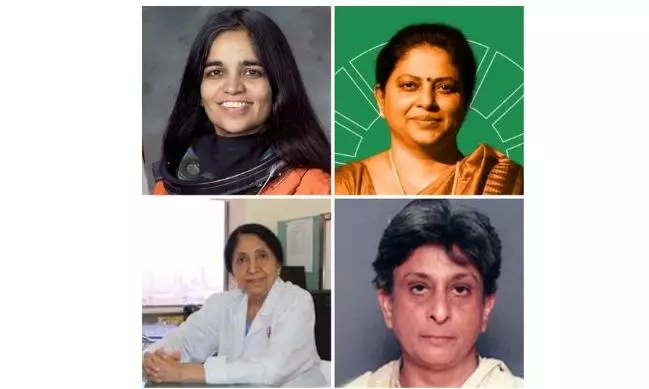
On the occasion of Science Day, let us try to recall a few women scientists whose contributions led to development in various areas.
1. Janaki Ammal (Botanist)
Born in Tellichery, Kerala, in 1897, Ammal was an Indian botanist who worked on cytogenetics and phytogeography studies. Kerala's rain forests helped her collect a wide range of medicinal and economic plants. She is known for her pioneering work in plant breeding and cytogenetics, particularly with sugarcane and brinjal. She helped develop high-yield sugarcane varieties.
2. Dr Aditi Pant (Oceanographer)
Pant is the first Indian woman to visit Antarctica in 1983, as part of an Indian geology and oceanography mission. She got a US government scholarship to pursue a master's degree in marine sciences at the University of Hawaii. She pursued her Ph.D. on the physiology of marine algae at London University's Westfield College. She has worked at the National Institute of Oceanography and National Chemical Laboratory. She played a crucial role in the 3rd and 5th Indian Antarctic Expeditions, contributing significantly to oceanography and geology, including the establishment of Dakshin Gangotri.
3. Dr Indira Hinduja (Gyanecologist & Infertility specialist)
She pioneered assisted reproduction in India and delivered India's first scientifically documented test-tube baby on August 6, 1986, at KEM Hospital. In 1991, she developed oocyte donation technique for menopausal women. She pioneered the Gamete Intrafallopian Transfer (GIFT) technique, leading to India's first GIFT baby.
4. Asima Chaterjee (Organic Chemist)
Recipient of numerous awards including the prestigious Padma Bhushan, Chaterjee made significant contribution to organic chemistry. She was the first Indian woman to earn a Doctorate in Sciences. She is renowned for her research in phytochemistry, specifically developing anti-epileptic drug Ayush-56 and anti-malarial drug Ayush-64.
5. Kamal Ranadive (Pioneering Cancer Research)
Ranadive was a biomedical researcher, who played a crucial role in understanding the connection between cancer and viruses. She also worked on leprosy and tuberculosis, advancing medical research in India.
6. Masha Nazeem (Innovator)
Though a young student, Masha Nazeem, from Tamil Nadu is a serial innovator and has developed eight interesting projects including the flameless seal maker, which won her an award in IGNITE 2009 contest of National Innovation Foundation. It features a rechargeable batter or mains-powered, heat-controlled compartment for melting wax and a manual piston for precise and uniform seal application, which is ideal for use in polling stations for safe, confidential and quick document sealing. She also designed a train toilet that would keep the railway tracks at stations free from filth and stench. The invention gave her an opportunity to rub shoulders with global experts at the World Toilet Summit in Delhi.
7. Kalpana Chawla (Indian astronaut)
Born in a family that migrated to India from Pakistan and settled in Haryana, Kalpana Chawla became a renowned astronaut of Indian origin. She pursued her degree in aeronautical engineering at Punjab Engineering College, Chandigarh and then moved to the US to pursue advanced studies in aerospace engineering, with specialization in fluid dynamics and aerodynamic behavior in flight systems. She was selected to NASA's astronaut program and flew her first mission aboard the space shuttle Columbia in 1997. During her second mission in January 2003, she, along with six other crew members, were killed when Columbia disintegrated during reentry. Chawla was posthumously awarded several of NASA’s highest civilian honors. Former PM Atal Bihari Vajpayee dedicated the country's first satellite launched in 2002 as METSAT-1 to Chawla and renamed it as Kalpana-1 in 2003.
8. Tessy Thomas (India’s Missile Woman)
A scientist at the DRDO, her profession focused on missile guidance, navigation, and mission design within India's strategic weapons programs. She worked on India's long-range missile development effort, Agni missile program. She was the project director for Agni-IV and Agni-V, becoming the first woman to head long-range missile programs in India. These milestones in her career earned her the name Missile Woman and Agni Putri. She won several nation and institutional honors.
8. Sunita Sarawagi (Computer Scientist)
She is a computer scientist known for her research in databases, data mining, machine learning, including the use of natural language processing to extract structured data from text. Sarawagi has transformed how computers process unstructured data through innovations like semi-Markov conditional random fields. She also played an institutional role in shaping AI and data science initiatives at IIT Bombay.
Science and technology focus on gaining knowledge that can be applied for the benefit of humanity. This year's theme aims at gender inclusivity with focus on empowering women in STEM, bridging gender gaps and leveraging women's scientific capabilities to make India become a knowledge-driven and developed nation.

