Why the Bhagavad Gita a Manual for Living, Explains Swami Swarupananda

4 Feb 2026 4:24 PM IST4 Feb 2026 4:24 PM IST
Swami Swarupananda, Global Head of Chinmaya Mission, explains the vision behind Gita Panchamrit, dismantles myths around renunciation, and makes a compelling case for the Bhagavad Gita as a timeless guide for purposeful, peaceful living.
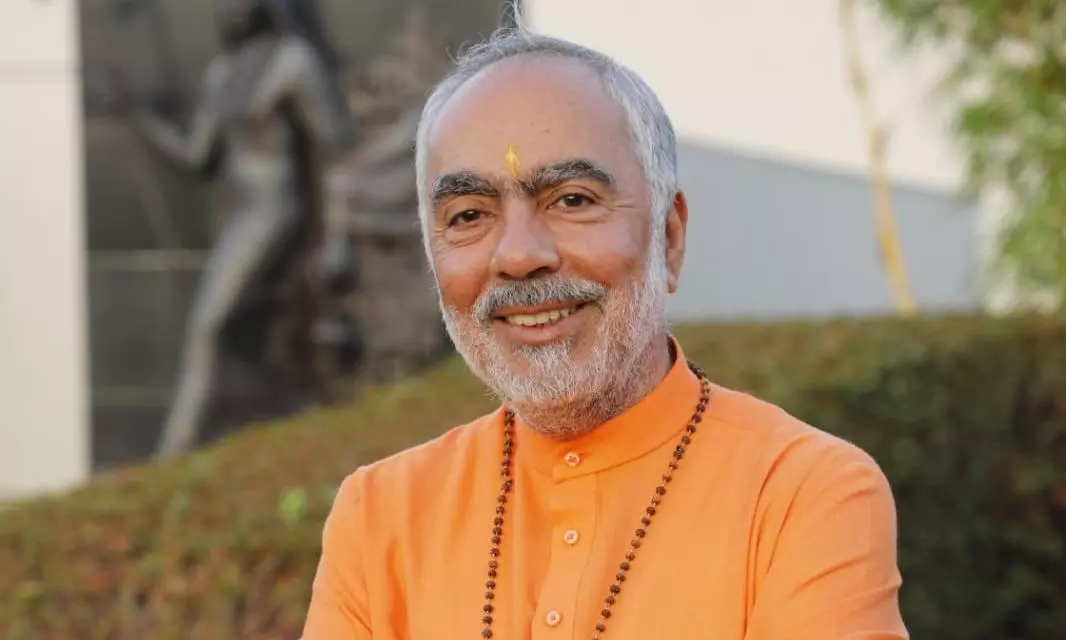
Swami Swaroopananda ji
When Swami Swarupananda speaks about the Bhagavad Gita, it is not as a distant scripture or a religious text meant for ritual reading, but as a living body of knowledge meant to be practised, lived, and transmitted across generations. As the Global Head of Chinmaya Mission, he sees the Gita not as something exclusive, but as a shared cultural and philosophical anchor that can unify people while transforming individual lives.
Explaining the vision behind Gita Panchamrit, Swamiji says the idea is both simple and deeply ambitious. “If every Bharatiya knows at least five verses of the Bhagavad Gita to chant, we’ll have something in common that unifies us,” he says. At the same time, he points out that the Gita is “such an amazing source of life knowledge” which many have drifted away from because of unfamiliarity with Sanskrit and a lack of exposure to its meaning.
“These five verses pretty much tell us what we should do, and what the whole universe, what Bhagavan does for us,” he explains. “If we do this, we will find that we can make life meaningful, purposeful, transformative, productive, peaceful, happy.”
Swamiji acknowledges that every verse of the Bhagavad Gita is a gem, but also accepts a practical reality. “Most people may not study all of them. But at least five verses, if everybody knows and passes it on over generations, we will keep this eternal Dharma alive.”
The first verse he highlights comes from the sixth chapter: uddhared ātmanātmānaṁ na ātmānaṁ avasādayet. Its message, he says, is unambiguous. “Lift yourself by yourself, and having lifted yourself, don’t allow yourself to fall back.” It is also, he adds, a reminder not to underestimate one’s own potential. “Your mind is your best friend. Your mind is your worst enemy.”
The second verse, karmaṇye vādhikāraste, is perhaps the most quoted — and misunderstood. Swamiji is quick to clarify that it does not advocate indifference to results. “It does not mean don’t expect results,” he says. “It means do your action in the present to the best of your ability. The result will depend on your performance, not on your wishes or expectations.”
He calls this verse a sutra because of its layered meanings. “Karma which normally binds you becomes yoga to uplift you,” he explains. “Do your best, but do not worry about the result. The result comes according to the laws of the universe, not according to our whims and fancies.”
Swamiji points out how much stress arises from unjust expectations. “Less work, more pay. Immediate success without efficient action,” he says. “When that doesn’t happen, we feel the world is unjust. It’s not unjust — our expectations are.”
He adds that actions benefit us far beyond outcomes. “Perform to transform yourself. Perform to express your potential. Not just to get something out of it.” At the same time, Krishna warns against paralysis born of anxiety. “Very often we are so anxious about results that we become incapable of acting in the present. Therefore, do not be attached to inaction.”
The next verse speaks of dedication and surrender — not in a passive sense, but as a powerful inner attitude. Swamiji explains that when actions are performed out of gratitude and love, they carry inspiration within them. “Whatever you do, whatever you consume, whatever you give, whatever austerities you practise for self-development — when you dedicate it, you stop worrying about who will look after you.”
He urges a broader understanding of God. “God is not someone sitting up there condemning you. That all-pervading Lord is present in everyone. When we fold our hands and say Namaste, we are acknowledging that oneness.”
When actions are performed in this spirit, Swamiji says, Krishna makes a promise. “Success will be brought to you. You don’t have to chase it. And what needs to be preserved — your values, your growth, your well-being — ‘Shema vahamyaham’, I will preserve it for you.”
The final verse of the Panchamrit, sarva dharmān parityajya, is often misunderstood as a call to renunciation. Swamiji firmly rejects this idea. “It does not mean giving up action,” he says. “It means giving up identification with your limited body, mind and intellect.”
Krishna’s assurance, he explains, is liberation not from some abstract sin, but from agitation itself. “From all causes of sorrow, all disturbances of the mind, all compulsions of action. ‘Maa shuchaha’ — you have no occasion to grieve.”
This idea flows into Swamiji’s larger view of the Gita as a guide to living, not an escape from life. “What is religion without life? And what is life without a spiritual foundation?” he asks. “Bhagavad Gita teaches us to make our entire life a worship.”
Addressing concerns about today’s distracted youth, Swamiji is both realistic and reassuring. “Which generation was not distracted?” he asks, smiling. While social media has intensified restlessness, the solution remains unchanged. “Bring your mind where your hands are working. Determine your role and do your duty.”
For students, he says, this clarity is critical. “If your primary duty is not performed, you don’t just lose out in the future — even your desires will not be fulfilled.”
When discussing the famous dhyāyato viṣayān puṁsaḥ verses, Swamiji calls them a clear warning about the ladder of fall. “When we keep fantasising about objects, situations or people, dependence is born. Desire becomes compulsion. Obstruction turns into anger. Anger leads to delusion, loss of memory, loss of discrimination — and finally, self-destruction.”
Anger, he stresses, burns the person who holds it before it burns anyone else. “Without discrimination, what is a human being?” he asks pointedly. “Don’t insult animals — even they don’t behave that way.”
Krishna’s solution, Swamiji says, is not force but strategy. “Vairagya is protecting the mind from distractions that take you away from your goal. Abhyasa is regular practice. The mind becomes your friend when you train it patiently.”
On education, Swamiji is equally candid. “Today education develops the head, not the heart,” he says. While Chinmaya Mission runs schools, colleges and a university, he believes the real revolution lies elsewhere. “We don’t need to open thousands of schools. Existing schools must take up value-based education.”
He reminds us that knowledge without values becomes obsolete quickly. “Education must build character,” he says, echoing Swami Vivekananda.
Finally, addressing the persistent myth that the Gita promotes renunciation, Swamiji is unequivocal. “This is a ridiculous notion,” he says. “The Gita was given to Arjuna when he wanted to renounce action. Krishna told him to do his duty.”
Renunciation, he explains, is not about withdrawing from life but giving up selfishness. “What is to be renounced is our negativities — never our responsibilities.” Even sanyasis, he adds, “work more than corporate heads, not for themselves, but for the world.”
The five verses of Gita Panchamrit, Swamiji believes, can quietly dissolve generations of misunderstanding. “I didn’t speak about renunciation anywhere,” he says. “These verses teach action, responsibility, gratitude and clarity.”
As Krishna himself reminds us, Swamiji concludes, “Lift yourself by yourself.”


Next Story